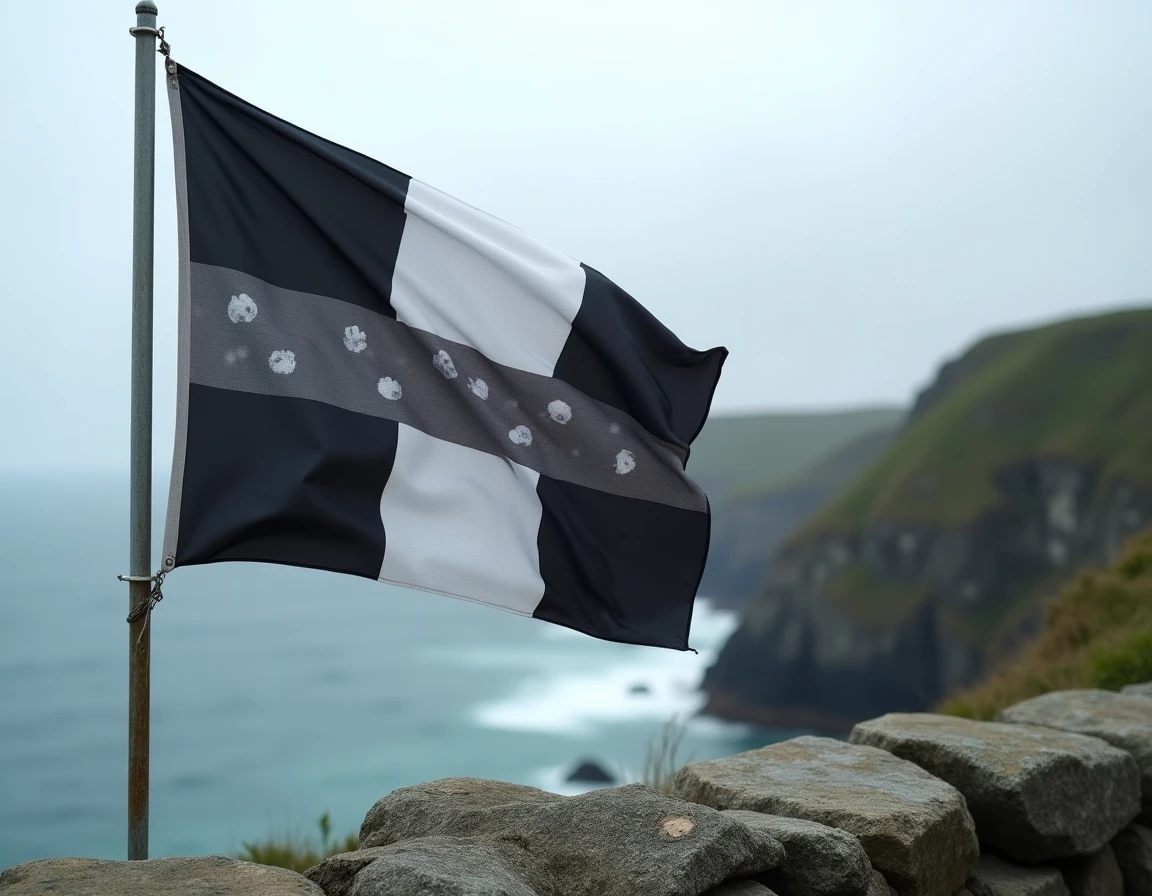
We often come across the Gwenn ha Du without really knowing what we are looking at. On a fest-noz capital, in the stands during a Stade Rennais match, on the façade of a town hall in Loire-Atlantique: this black and white flag is displayed everywhere, but its meaning remains unclear for most people. Understanding the significance of the Breton flag is to trace a thread that intertwines medieval heraldry, early 20th-century activism, and contemporary popular appropriation.
The Gwenn ha Du, a flag without color or ancient historical precedent
Contrary to what one might assume, the Gwenn ha Du is not a legacy of the Middle Ages. Its creation dates back to the years 1923-1925, initiated by Morvan Marchal, a young architect affiliated with the Breton National Party. The idea of giving Brittany its own standard was born within a small nationalist circle, at a time when European regionalist movements were seeking strong visual symbols.
Marchal drew inspiration from two distinct graphic sources. On one side, the coat of arms of the city of Rennes, with its horizontal stripes. On the other, the American Stars and Stripes, from which he borrowed the principle of alternating stripes topped with a canton filled with motifs. By studying the history of the Breton flag, one realizes how unusual this dual lineage is for a French regional emblem.
The result is a strictly black and white flag, making it the only flag in the world devoid of any color in the chromatic sense. This radical graphic choice partly explains its immediate readability and ease of reproduction on any medium.

Nine stripes of the Breton flag: the map of the dioceses coded in black and white
The nine horizontal stripes are not decorative. Each stripe represents one of the nine historical countries of Brittany, distributed according to a precise linguistic logic.
- The four white stripes correspond to the Breton-speaking countries (Bretonnants): Léon, Trégor, Cornouaille, and Vannetais.
- The five black stripes represent the Gallo or Romance-speaking countries: Rennes, Nantes, Dol, Saint-Malo, and Saint-Brieuc.
This distribution reflects the linguistic duality of historical Brittany, between Upper Brittany (Gallo) and Lower Brittany (Breton). The flag functions as a simplified map of the ancient dioceses, compressed into alternating stripes.
It is noteworthy that there are five black stripes and four white ones, creating a slight visual asymmetry. This imbalance simply reflects the geographical reality: the Romance-speaking countries occupied a slightly larger territory.
Hermine spots: origin of the motif and associated legend
The upper left canton of the Gwenn ha Du bears eleven black ermine spots on a white background. This heraldic motif predates the flag itself by several centuries. The ermine has appeared on the arms of the Dukes of Brittany since the Middle Ages, and its use as a Breton symbol far predates any modern political claim.
The animal that bears this name, a small mustelid, has a coat that turns white in winter when temperatures drop sufficiently. The heraldic spot stylizes the black tip of the ermine’s tail against a background of white fur. In heraldry, the entire animal is not drawn: a geometric pattern in the shape of a three-pointed cross is reproduced.
The legend of Duchess Anne and the ermine
A popular tradition, difficult to date precisely, tells that an ermine pursued by hunters would rather die than cross a muddy pond and soil its white fur. From this scene arises the motto “Potius mori quam foedari” (rather death than dishonor), associated with the Dukes of Brittany.
Historians remain cautious about the actual antiquity of this tale. The legend was mainly popularized in the 19th century, in a context of regionalist romanticism. Nevertheless, it serves as an effective founding narrative, linking the animal, the territory, and a moral value.

From nationalist symbol to popular emblem: the recent shift of the Gwenn ha Du
The political journey of this flag is far from linear. After its creation, French authorities viewed it with suspicion, even banning it, considering it a symbol of separatist provocation. The ties of some members of the Breton movement with the occupier during World War II further burdened this charge.
The shift occurred gradually from the 1960s-1970s, driven by the Breton cultural revival (music, language, festivals). Since the 2010s, several researchers and political leaders have emphasized that the Gwenn ha Du is now seen as a widely depoliticized and unifying symbol. The deputy mayor of Nantes in charge of Breton issues referred to it as “the popular emblem of an entire region” in 2023, during the centenary celebrations.
This reclassification as “centenary” in 2023 has itself sparked debates among historians. The creation spans from 1923 to 1925, and the first documented public appearance dates more to the 1930s. The media crystallization around 1923 as a reference year is a narrative choice, not a historiographical certainty.
Gwenn ha Du and Bigouden flag: do not confuse Breton emblems
Sometimes the Gwenn ha Du is confused with the flag of the Pays Bigouden, which features red and yellow stripes. The two have neither the same origin nor the same meaning.
- The Gwenn ha Du represents the entirety of historical Brittany (five departments, including Loire-Atlantique).
- The Bigouden flag is a local emblem, limited to the southwest of Finistère, and its colors refer to other heraldic traditions.
- The kroaz du, another Breton flag (black cross on a white background), is even older but less known to the general public.
On the ground, during festivals or gatherings, the Gwenn ha Du overwhelmingly dominates in terms of visibility. The kroaz du or the Bigouden flag appear mainly in specific local or historical contexts.
The Breton flag remains an object that is both simple in its form and dense in its historical ramifications. Its stripes encode a linguistic geography, its hermines extend a ducal heraldry, and its massive adoption by the population has ultimately erased the political charge of its origins. It is probably the only French regional flag that can be recognized in a split second, at any distance.