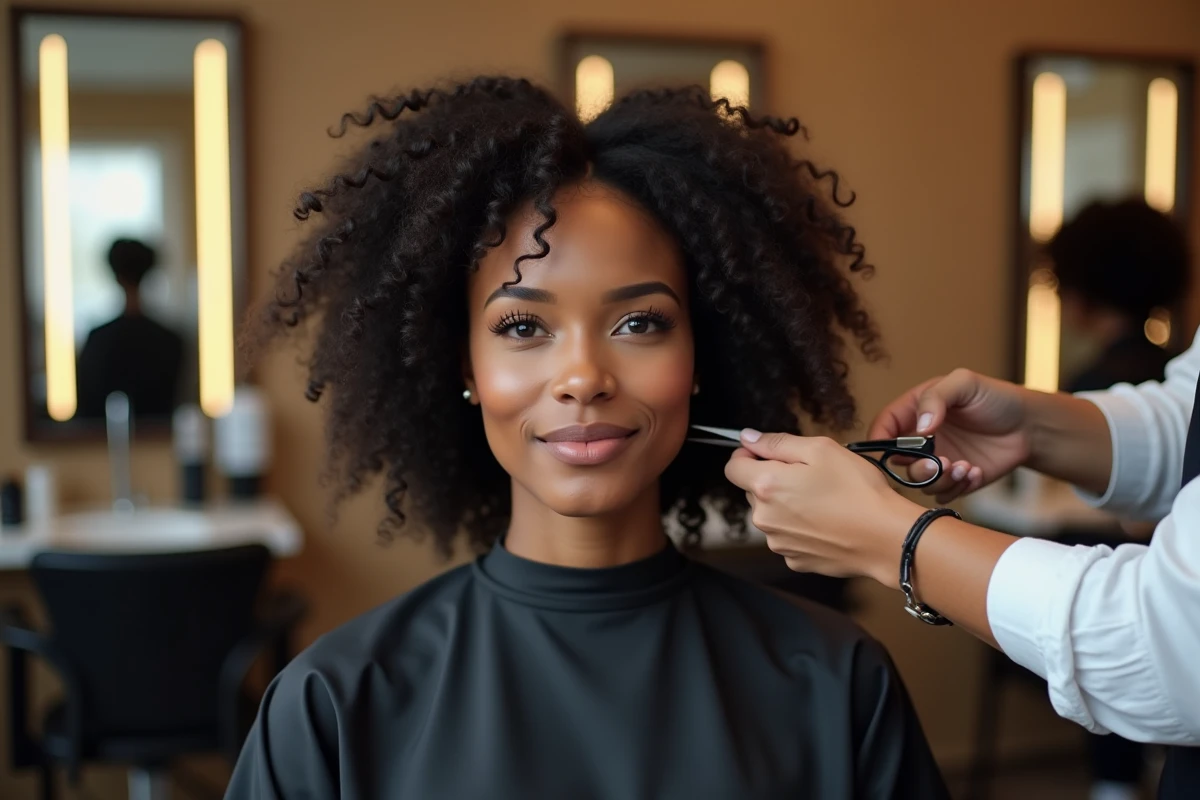
Curly hair loses its definition as soon as its structure is touched without care. Thinning, a common technique to reduce volume, poses a specific problem for this type of fiber: it modifies the natural spring of the curl. Before asking for a sculpting scissor cut, it is better to understand what is really happening in the strand.
What thinning causes on curly fiber
You may have noticed that a curly strand cut too short does not fall like a straight strand? It rises, sometimes unpredictably. This is shrinkage, the natural shortening due to the spiral of the hair.
Classic thinning, done with sculpting scissors, creates uneven lengths within the same strand. On straight hair, these length differences remain discreet. On curly hair, each strand cut shorter rises to a different level. The result: curls that no longer form uniformly.
The sawtooth cut also weakens the already dry areas of the fiber. Hairdressers trained by specialized schools like Cut It Kinky and Curly Hair Artistry report a correlation between repeated thinning and an increase in split ends and breakage on textured hair. Curly fiber, naturally more porous at the ends, does not tolerate this mechanical aggression well.
Another rarely anticipated effect: excessive thinning increases moisture absorption in the lengths. Technical protocols from brands like Ouidad document this phenomenon. Thinned strands absorb water unevenly, which accentuates an unbalanced shrinkage, with some curls rising much more than others. For those looking for detailed advice and tips on thinning curly hair, this dimension is often the tipping point between a controlled result and a chaotic hairstyle.

Thinning on curly hair: cases where the technique is justified
Condemning thinning outright would be excessive. On some very dense hair types, volume becomes a real comfort issue. The hair weighs down, pulls on the scalp, and the curls flatten under their own mass instead of bouncing.
The question to ask the hairdresser is straightforward: does the volume come from the thickness of each hair, or from the number of hairs on the head? The answer changes the technique.
- If the hair fiber has a wide diameter (individually thick hair), light thinning on the internal lengths can lighten without breaking the surface curl
- If the volume comes from high density (many fine hairs), thinning risks creating a fluffy effect and surface frizz, as the shortened strands do not have enough weight to curl properly
- On 2b-2c wavy hair, moderate thinning works better than on tight 3b-4a curls, where the spiral needs all its length to form
Proper thinning on curly hair is done sparingly. It targets the internal areas of the hair, never the visible layers on the surface.
Slice cutting and carving: alternatives to sculpting scissors
In recent years, salons specializing in curls have gradually abandoned sculpting scissors. The trend documented by trainers from Cut It Kinky and Curly Hair Artistry is moving towards internal cutting techniques on dry strands.
Slice cutting involves sliding the scissors along the strand rather than cutting across. The blade removes material gradually, without creating those step-like ends that disrupt the curl. The action takes longer, but the result preserves the natural spring.
Carving works on a similar principle: the hairdresser sculpts the inside of the hair mass by removing weight strand by strand, always on dry hair. Working on dry hair is fundamental for curls, as the actual length of curly hair only appears in its natural state. Cutting wet means cutting hair that appears longer than it is.
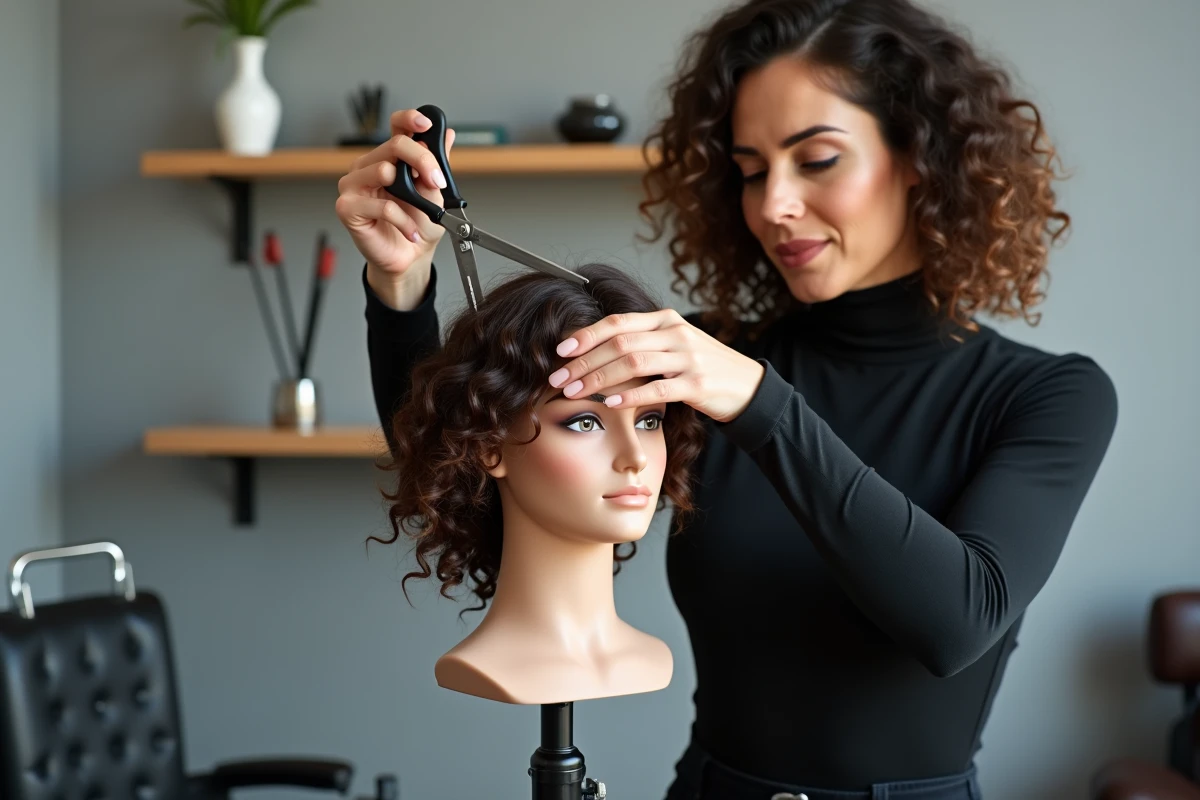
These techniques require a hairdresser trained in cutting textures. A classic layered cut done on wet hair with sculpting scissors will not produce the same effect as carving on dry hair.
Criteria for choosing between thinning and internal cutting in the salon
Before sitting in the chair, some concrete guidelines help steer the conversation with the hairdresser.
- Ask if the cut will be done on dry or wet hair. A curly hair specialist almost always cuts on dry hair
- Specify if you want to reduce overall volume or simply refine the ends. The two goals require different techniques
- Inquire about the tool used: sculpting scissors (classic thinning), straight scissors in slice cutting, or a razor. Each tool leaves a different finish on the strand
- If you have tight curls, ask for a test on a less visible strand before treating the entire head of hair
A well-thought-out layering, with lengths framing the face and lightness in the ends, often reduces perceived volume as much as thinning does, without the downsides to texture.
Maintenance after a thinned cut
Thinned ends dry out faster than blunt-cut ends. A moisturizing treatment applied to the lengths after each wash limits breakage. Products containing glycerin or aloe vera help maintain the fiber’s moisture balance.
Spacing out thinning is also a relevant strategy. Rather than having the hair thinned out at every salon visit, alternating with a structured cut using straight scissors allows the fiber to regenerate between sessions.
Thinning is not a trivial act on curly hair. It can lighten a suffocating mass of hair, but it can also transform defined curls into a cloud of frizz. The difference lies in the diagnosis made before the cut, the tool chosen, and the hairdresser’s technique. It is better to have a professional who refuses to thin when it is not appropriate than another who instinctively reaches for the sculpting scissors.