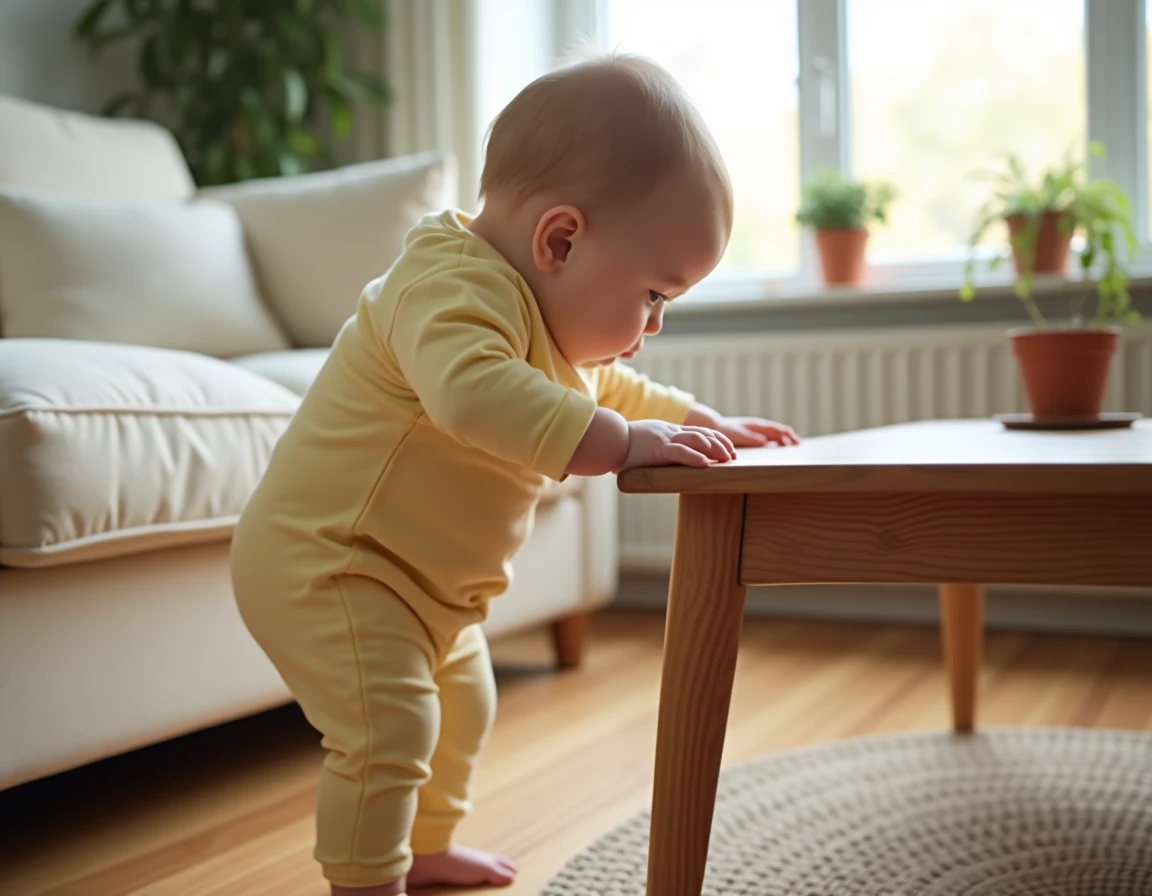
The age at which a baby takes their first steps varies dramatically from one child to another. Late walking in babies regularly fuels the idea that it may be linked to a form of superior intelligence. The available data allows us to measure how founded this hypothesis is, and especially to identify the factors that truly impact the motor timeline.
Age of independent walking: what the data really measures
The WHO documents independent walking as normal between 8.2 and 17.6 months, which is a window of nearly ten months. This range does not reflect a measurement inaccuracy. It reflects the real biological diversity of motor trajectories in children without pathology.
| Child Profile | Average Walking Age | Link with Later IQ |
|---|---|---|
| Early walker (before 10 months) | About 9-10 months | No demonstrated correlation |
| Average walker | About 12-13 months | No demonstrated correlation |
| Late walker (after 15 months) | 15-18 months | No demonstrated correlation |
| High potential child | Great heterogeneity (sometimes after 17 months) | Language often advanced, motor skills variable |
A longitudinal study from the University of Zurich concluded that differences in walking age do not predict IQ or academic performance. Late walkers without any particular disorder catch up with their peers in terms of motor skills, usually before entering kindergarten.
The relationship between late walking and intelligence development is based more on anecdotal observations than on solid statistical evidence. Among children identified as high potential, the true constant remains the great heterogeneity of their development: very advanced language often coexists with average or even below-average motor skills.

Socio-emotional development and late walking: the overlooked aspect
While late walking does not predict intelligence, it does show a modest association with variations in socio-emotional development. The same Zurich studies note that late walkers more often exhibit traits of caution, inhibition, and a desire for closeness to adults.
This temperamental profile is not pathological. A child who observes for a long time before taking action accumulates information about their environment. They mentally test motor sequences before executing them. This seemingly slower learning strategy is part of a cognitive functioning that prioritizes safety over spontaneous exploration.
On the other hand, in a child who simultaneously shows a delay in walking, a lack of babbling, and poor eye contact, the combination of signals justifies a neurological evaluation. Isolated motor delay does not have the same significance as motor delay associated with other markers.
Environmental factors and time on the ground: the most underestimated cause
Since the reinforcement of recommendations on “tummy time” and the reduction of time spent in bouncers or strollers, several research teams (notably from Australia and Canada) report a rise in consultations for delayed walking in healthy children. The identified cause is not neurological. It is environmental.
A child who spends most of their day in a semi-sitting position (bouncer, car seat, stroller) has fewer opportunities to strengthen the muscle chains necessary for acquiring standing balance. Environmental factors that delay walking without underlying pathology include:
- Insufficient time on the ground in a prone position, which limits the strengthening of the trunk, hips, and foot supports
- Prolonged use of supportive devices (walker, bouncer, playpen) that reduce free exploratory movements
- An unsuitable home environment, lacking low furniture that allows the child to pull themselves up and take their first steps with support
These findings suggest that delayed walking often reflects a deficit in motor opportunity rather than a developmental disorder. The distinction between the two scenarios relies on clinical assessment of muscle tone, movement quality, and neurological reactivity.

Genetics, morphology, and tone: the biological variables that modulate the timeline
Beyond the environment, several biological parameters directly influence the age of walking.
Family history is the most reliable predictor. A parent who walked late themselves increases the likelihood that their child will follow a similar trajectory. This hereditary component concerns neuromuscular maturation and bone density, not intelligence.
- Body proportions play a direct mechanical role: a child with a proportionally heavy head compared to their trunk must develop finer balance before letting go of their supports
- Baseline muscle tone varies from child to child, with some exhibiting benign physiological hypotonia that extends the acquisition phase without constituting a pathology
- Prematurity shifts the motor timeline: developmental assessment should then be done using corrected age, not chronological age
The actual pathological causes of delayed walking (neurological disorders, hip pathologies, muscular dystrophies) remain rare. They are distinguished by associated signs: asymmetry of movements, lack of progress over several months, detectable tone anomalies during clinical examination.
When to consult for delayed walking
Pediatric societies recommend evaluation if the child is not walking independently by 18 months. This threshold does not mean that a problem certainly exists. It triggers an assessment to rule out neurological or orthopedic causes that would benefit from early intervention.
The age at which a child walks does not measure their intelligence or academic potential. The available longitudinal data converge on this point. The only reliable indicator of a problem remains the combination of signals (motor delay, language delay, tone anomalies), not the age of walking taken in isolation.